Wednesday, March 30, 2011

Dooyeweerd Quote for the Day

Herman Dooyeweerd

As soon as Christianity began to compromise learning, culture, and political life with pagan and humanistic philosophy, with its view of state and culture, Christianity's inner strength was broken. At that moment the process of "becoming like unto the world" began, repeatedly arrested through the grace of God by a spiritual reveil, a Reformation.
from The Christian Idea of the State

Tuesday, March 29, 2011

Omnibus Readings, Part 2


Continuing with a discussion of the integrated approach to history, literature, theology, and other subjects that is contained in the Omnibus series, several more points need to be made.

First,  these materials from seventh grade through twelfth grade are all suitable for and beneficial to adults.  With a bachelor's degree in history and English, a master's degree in education (nothing to brag about here), 30 additional graduate hours mostly in history, 30 years of classroom experience, over 40 years of reckless book buying and reading, 10 years of driving a diesel automatic 70 passenger school bus, and 10 years of coaching elementary basketball, I have received more education from teaching in a classical Christian setting than in my other educational experiences.  As George Grant has often lamented, "I have been robbed."  This series begins the restitution.

Second, teachers who are not using the Omnibus series, but who need additional teaching resources, would find these books useful.

Third,  having the "right list of books" and solidly Christian interpretive essays and scripted assignments are still no substitute for the teacher who can romance the subject, capture the hearts of his or her pupils, and translate the power of literature into classroom fire.  But it is a lot easier to transform students with Shakespeare and Homer and Jane Austen and C.S. Lewis than with a bland reader or textbook.

Fourth, adults should be buying these Omnibus texts and starting reading groups.  There is no reason why the kids should have all the fun.  Yes the textbook along with the 20 or more actual texts would cost a chunk of money.  But when we compare the costs of these readings to the money we routinely pay for cable television, cell phones, and other luxeries, the Omnibus program is quite cheap. 

Now, back to the books to be read on the Ancient, Biblical, and Classical worlds:


15. Mythology by Edith Hamilton.  I have long used and enjoyed teaching this book.  And I wrote the chapter on it for Omnibus IV.

16. Plutarch's Lives, Volumes I and II.  I have only read portions of these biographical sketches of famous Greeks and Romans.  Another gap in my knowledge.

17. The Last Days of Socrates and The Republic by Plato.  I find Plato a bit harder to read than his student, Aristotle.  I like Aristotle's Politics, but both ancient fellows are good foundation blocks for understanding the evening news.

18. The Early History of Rome and The War With Hannibal by Livy.  Anyone wanting to cheat on the second volume can read Ernle Bradford's book Hannibal for a quicker view of the Punic Wars.

19. The Aeneid, Eclogues, and Georgics by Virgil.  After reading Virgil, you will understand why I thank God that his command to burn his manuscripts was disobeyed and why Dante chose him to be the guide through much of The Divine Comedy.


20. The Apocrypha.  We Protestants insist, rightly, that these writings are not the Word of God, and then we, wrongly, ignore them for their historical and literary value.

21. The Twelve Caesars by Suetonius.  I read modern historian Michael Grant's book with the same title, but the serious student goes back to the sources.

22. Cicero: Selected Works.  Cicero was an outstanding orator, political commentator, and rhetorician.

23. Annals of Imperial Rome by Tacitus. At last, a Roman historian I have read from, but, alas, not enough.

24. Metamorphoses by Ovid.  The young Francis Schaeffer read this work because it was defining for Western Civilization, and that led him to read the Bible.  Ovid is a great read that can be digested in small portions.
25. The Jewish War by Josephus.  You cannot rightly make sense of much of the New Testament and particularly Jesus' teachings without you have read this book by Josephus (to paraphrase Mark Twain).

26. Meditations by Marcus Aurelius.  A politician who thinks!  It actually happened. But Marcus Aurelius' thoughts/meditations were not in line with his harshness toward Christianity.

27. Apostolic Fathers edited by J.B. Lightfoot and J. R. Harmer.  This book was the inspiration for the song "Gimme that ole time religion."  Not really, but it should have been.  Protestant and Reformed Christians have emphasized the Reformation, rightly, and ignored the Early Church, wrongly.

28. Augustus Caesar’s World by Genevieve Foster.  I don't even own this book!  Call 911!

29. The Eagle of the Ninth by Rosemary Sutcliff.  A fictional account designed to better acquaint kids with Roman history.  (And I don't own it either, but I think my kids have read it.)

30. The Best Things in Life and The Unaborted Socrates by Peter Kreeft.  Kreeft is an amazingly gifted Christian writer who really wants to get Socrates into heaven.  What he does is get the ideas and methods of Socrates into students.  I have not read and used these books, but I love Kreeft's Socrates Meets Jesus.

We are now through the seventh and tenth grade years in our reviewing of the Omnibus reading list. 

Monday, March 28, 2011

The Omnibus Books and Readings, Part 1

I recently posted some information about the Veritas Press Omnibus series.  I want to say more about this ambitious program of learning.  First of all, the word omnibus is a Latin term meaning, "all encompassing" oe "everything."  In particular, this series of studies seeks to combine history, literature, theology, the Bible, philosophy, rhetoric, composition, speech and debate, critical thinking and logic, and art.  That is not to say that certain of those subjects cannot be or need not be studied separately from this series.  But this is learning as a whole or thinking in a world-view fashion. 

Sometimes the terms "Great Conversation," "Great Books," and "Great Ideas" have been used for this kind of approach to learning. The traditional, and often watered-down, dumbed-down, and dulled textbooks have their place in the learning process. I am just not sure what that place is.  Instead of the often mundane hash of committee produced textbooks, why not read the great classics?  All too often, Mark Twain's quip is right:  A classic is a book that every talks about, but nobody reads.  An education, by definition, should entail reading the best and most profound books ever written.

Reading the great books (and everyone's list of the canon of great books will differ at points) entails some hard rides, some barren deserts, some craggy summits, and some overwhelming currents.  Yes, there are page turners among the great books, but many involve a real need for mental discipline.  It is the end result more often than the process that pays the rewards.

The Omnibus program carries the student from grades 7 through 12 through a host of great literary classics, including poems, plays, and novels,  philosophical treatises, political writings, biographies and histories, and all 66 books of the Bible.  Each textbook contains extensive essays on the background and worldviews of the books, all interpreted from a Christian perspective.  Each chapter includes assignment sections that provide innovative and in-depth opportunities for students to better learn the material and develop writing and thinking skills growing out of their readings.

The Omnibus series (I like the name Omnibus Institutes) entails readings in this order:
7th Grade--Biblical and Classical Civilizations
8th Grade--Church Fathers through the Reformation
9th Grade--Reformation to the Present
10th Grade--The Ancient World
11th Grade--The Medieval World
12th Grade--The Modern World

As you can see, the pattern is Ancient, Medieval, Modern, with each period covered twice. 

Below are most of the books that are read for the 7th and 10th grade studies on the Ancient, Biblical, and Classical world.  I have included a sentence regarding each book.


Omnibus I Biblical and Classical Civilizations

Omnibus IV The Ancient World

Books included in Omnibus I and Omnibus IV

The Ancient World of Biblical and Classical Civilizations

1. Epic of Gilgamesh.  Great study of the warped and depressing worldview of the Mesopotamian cultures. Great contrast between the life of Gilgamesh and that of Abraham.

2. Code of Hammurabi.  A great study for seeing the difference between man's lawcodes and that which God revealed to Moses.

3. The Iliad and The Odyssey by Homer. No education is complete (or maybe even started) without reading these two powerful and defining classics.  The first shows man's mortality and the second shows the art of storytelling, amongst other things.

4. Histories by Herodotus.  The study of history is rooted in inquiry.  Why do things happen as they do? Huge defining text.

5. The Peloponnesian War by Thucydides.  Next year I hope to teach this classic work for the first time.

6. The Bacchae by Euripides. I love teaching this warped incarnation tale during the Advent season.  Thank God for the True Incarnation.

7. Clouds by Aristophanes. A comedy on my reading horizon.

8. The Hippocratic Oath.  A writing we all hear about, but rarely see.

9. Nicomachean Ethics and Poetics by Aristotle.  As C.S. Lewis and others have said, books about Aristotle are hard to read, but Aristotle himself isn't that difficult.

10. The Oresteia Trilogy (Agamemnon, Libation Bearers, and Eumenides) by Aeschylus.  Three great plays which make better sense when read together.

11. Theban Trilogy (Oedipus Rex, Oedipus at Colonus, and Antigone) by Sophocles.  Another great threesome.  Antigone is usually a favorite among students.

12. Thirteen Books of Euclid’s Elements.  I always assumed in high school that my teacher studied under Euclid.

13. On the Nature of Things by Lucretia.  Not having been classically educated, I know almost nothing of this book.

14. Aesop’s Fables.  These are not just children's stories.  Luther loved this work.

More of the Ancient readings, particularly the Roman writings, will be discussed in an upcoming post.

Saturday, March 26, 2011

Readings Rounding out the Month of March

Morning and evening and in the times in between, I have enjoyed some helpful readings this month.  I have several books that are either about to be finished or have been finished this month.  There are quite a few others that have been tasted, dipped into, started, skimmed, scanned, surveyed, and looked upon with an envy toward faster readers.

Last year I read Os Guinness' book--The Call: Finding and Fulfilling the Central Purpose of Your Life.  This book is great for a month's morning reading, in that it is divided into 26 chapters, designed to be read one day at a time.  When I finished reading it last year, I was determined to keep it close for a second reading.  It is just as fresh and refreshing, just as instructive and inspiring, just as motivating and moving, as it was on the first reading.  On second thought, it is moreso.  My son, Nicholas, and I recently found a used, but nice copy of the book, so he bought it and has also enjoyed reading it.  We have tentative plans for having an evening study--you are all invited--on this book.


Victor Davis Hanson is one of the greatest proponents of classical education in the country today.  His specialty is the old Greek classics, such as those writings of Homer, Herodotus, and Thucydides.  And since he has such a heart for classical literature, he has an incredibly rich foundation for analyzing modernity.  The Father of Us All: War and History--Ancient and Modern is a collection of previously written essays and book reviews.  This is an incredibly interesting and informative book.  In an essay I finished just this morning, Hanson showed how our short-sighted criticisms of the failures or mistakes of the military in our current wars should be understood in the light of our own military history.  All our wars and skirmishes have been filled with mistakes, misjudgments, leadership blunders, and failures.  The victories, as well as the defeats, were never flawlessly achieved.  The chapter ends with a Churchill quote:
"Never, never, never believe any war will be smooth and easy, or that anyone who embarks on the strange voyage can measure the tides and hurricanes he will encounter."
That Churchill quote is one that I am going to look at often.  I am not in a war, in the literal sense of the word, or on a voyage, but I am dealing with many battles, tides, and hurricanes.


For Humanities class, we are reading Les Miserables by Victor Hugo.  This is, I think, my third reading of this most powerful novel.  I feel guilty at night when I am comfortably propped up reading this book, under the guise of doing homeWORK.  The book is so compelling.  Hugo is a puzzle to me, but he penned a great novel.


Since our Humanities class is dealing with events from the French Revolution through the Napoleonic Age to the subsequent upheavals and revolutions in France and Europe, I am stacking up a veritable "leaning tower of Pisa"  book stack on things related to the French Revolution.  Quite helpful has been the short, powerful work titled The French and American Revolutions Compared written by Friedrich Gentz in 1800, translated by John Quincy Adams.  This book, so small as to fit into a shirt pocket, stands against a whole library of books purporting to make the American and French events of the late 1700s to be two sides of the same coin. 

I am still just barely into Christopher Dawson's book The Gods of Revolution.  He wrote quite a bit about the French Revolution, but this book is the only one in which he focuses on it totally.  I am finding myself frightened when wading into this book.  The powerful current of Dawson's intellect is daunting.

On some mornings, I am getting a page or two read of Gordon Clark's Historiography: Secular and Religious.  I read and appreciated this book a couple of years back.  I am working to own the contents of it during this reading, which will likely take several months.  When either Harvard or Princeton calls upon me to teach a class to history students, this book will be high on the required reading list.

Saturday, March 19, 2011

On the Reading Horizon--William Henry Harrison


When most people think of William Henry Harrison....Wait a minute, I forget that normal people almost never think of William Henry Harrison or even his grandson Benjamin Harrison. Perhaps they do think of Harrison Ford. I will start over.

When American history teachers think of William Henry Harrison, assuming they did not do graduate work on his career, they only have a line or two in their minds.  First, they will remember that Harrison served the shortest term in elected Presidential history--one month.  (In recent decades, Vice Presidents have been sworn in during times when the President was undergoing surgery or was in some way incapacitated. So, Vice President George H. W. Bush was sworn in during Pres. Reagan's surgery and Vice President Quayle was sworn in during Pres. G.H.W. Bush's surgery. Whether VP Biden is ever sworn in during Pres. Obama's vacations is not under examination.)  Concerning Harrison's one month term, more knowledgeable students will recall that he gave the longest inaugural address ever (which led, in part, to his subsequent illness) and that great controversy followed his successor's taking office, referring here to John Tyler, sometimes referred to as 'His Accidency.'

The second point usually remembered about Harrison is the catchy, and at its time, convincing campaign slogan:  Tippecanoe and Tyler, Too.  In a ruthless and invenctive campaign, filled with lots of sound and fury and little thought and wisdom, the association of the military victory of Harrison over the Indian tribes at the battle of Tippecanoe served to convince voters to elect him over the incumbent, Martin Van Buren.  Choosing between the two was similar to the weak choices we often face in Presidential elections.

Robert M. Owens is an Associate Professor of History at Wichata State University in Kansas.  This book, Mr. Jefferson's Hammer, grew out of his dissertation.  The book is published by the University of Oklahoma Press.  The OUP publishes many fine works on the history of the American west, Native Americans, and the 19th century.  This might well be expected from a university press located in Oklahoma.  Along with those areas of specialization, they also publish some outstanding studies of military history (the Campaigns and Commanders series) and ancient and classical studies. Like many fine university publications, the subtitles explain the book:  William Henry Harrison and the Origins of American Indian Policy.

This is an important study because Harrison's Presidency was an abrupt coda on the end of an influential career.  He appears in history at a time overlapping the eras dominated by Jefferson and Jackson and preceding the breaking up of the Union in the 1850s.  He was a Presidential candidate twice, but his greater role was on the mid-western frontier where he was not just an Indian fighter, but an administrator, territorial governor, and policy maker.  As the title says, he was President Jefferson's policy hammer.

Owens says, "Henry Clay was a far greater statesman, Andrew Jackson a far greater warrior, and Thomas Jefferson a far greater scholar.  But Harrison was on the ground in question, and his decisions, foolish and wise, had immediate impact.  He exercised tremendous authority over a vast area and was empowered to negotiate with numerous Native American peoples. He held extraordinary military and civil power for much of his tenure as Indiana's governor."

He further notes, "To this day we live with the echoes of Harrison's proclamations, the boundaries of his treaties, and the ramifications of his actions."

Far from being just a blip on the screen of Presidential history and trivia, Harrison had an illustrious, although maybe not admirable, career.  This book promises to be a good study.

Friday, March 18, 2011

Theodore Roosevelt Trilogy


Last night I completed a reading project that began in 1979.  Last night, I completed the third and final volume of Edmund Morris' biography of Theodore Roosevelt.  Colonel Roosevelt is a well crafted biography of the last of the full and eventful years of Roosevelt's life.  Each volume of the set, or each phase of Roosevelt's life, would have been worthy of reading, event-filled, and packed with more life than most people experience in the whole of their lives.

Colonel Roosevelt begins with the time after Roosevelt left the White House in 1909 (basically handing the keys over to his hand-picked successor, William Howard Taft).  For some time after his leaving office, Roosevelt was in Africa hunting and killing big game. Many animals were killed in the making of the book Col. Roosevelt.  From hunting lions to visiting European dignitaries, Roosevelt roamed Africa and then Europe. Back in America, he soon joined in and defined the opposition to his one-time close friend, Pres. Taft.  Roosevelt almost took the 1912 Republican nomination away from Taft.  Failing at that, he ran as an independent on what became popularly known as "The Bull Moose Party." 

The three way political divide in 1912 enabled Woodrow Wilson to win the Presidency.  (What an unfortunate result. Either Taft or Roosevelt would have been better.)  Roosevelt then went on a bruising exploration in Brazil.  His legendary energy and zeal enabled him to endure the hardships of this trip; however, it almost killed him. 

When World War I began in Europe, Roosevelt spoke and wrote about the issues often.  His disgust with the Wilson administration was ever increasing.  When the United States entered the war, Roosevelt's great hope was to be able to raise a division and serve in the military.  The Wilson administration prohibited such a possibility.  All four of Roosevelt's sons served in the war.  One was killed and two were injured.  Shortly after World War I ended, Roosevelt's many health problems led to his death in 1919.  Had he not died and had he remained in vigorous health (he was only 61 when he died), he could likely have won the Presidency back in 1920.

I was just a year out of college when I read the first volume of Morris' set--The Rise of Theodore Roosevelt. All readers of history, biography, and politics owe it to themselves to read a biography focusing on TR's early years.  Whether you like his politics or not, you cannot help but enjoy and be amazed at the incredible energy, brilliance, and rise of the man.  He was widely read (unbelievably so), athletic, charismatic (in the attractive personality sense), ambitious and manipulative, and incredibly gregarious.  I look forward to revisiting TR's early life in the future by reading David McCullough's Mornings on Horseback.  

There was a gap of over twenty years between Morris' first volume and his second. This was due to the time he spent working with the Reagan's and writing what was supposed to have been the definitive biography of Ronald Reagan.  Pres. Reagan had read The Rise of Theodore Roosevelt and liked it so much that he gave Morris the unprecedented opportunity to write a Presidential biography built upon almost unlimited access to the man himself.  Sad to say, Morris botched the Reagan biography.  He never understood Reagan and he inserted a fictional character in the book who described Reagan's life.

The second volume, Theodore Rex, covered the Roosevelt Presidency.  Lots of the book was detailed with particular legislative and executive battles of the years 1901 to 1909.  Nevertheless, there was always interesting details about Roosevelt's voluminous reading habits (while he was President) and his physical energy.  Of course, many of us in the conservative tradition wince frequently when considering Roosevelt's political philosophy and executive activism. 

I have tried to learn how to read biographies of past leaders without feeling like I have to agree or disagree with them.  I'm never going to vote for Roosevelt.  Being a southerner, if I had lived in that time, I would probably, have been voting for William Jennings Bryan (thank God for WJB and for WJB never winning the Presidency), Judge Alton Parker, and, sad to say, even Woodrow Wilson.  (Wilson was a southerner and a Presbyterian.)   The history student has to go beyond the "I agree" or "I disagree" views of politics past and question, instead, what ideas, views, and beliefs motivated the men of that time.

It is interesting to mentally try to fit Theodore Roosevelt into our times.  Although progressive and liberal for his time, most of his views would put him on the far right in our time.  Surely, he would have found abortion abominable and other moral divides quite shocking.  He is, in many ways, the father of American interventionism, but he would certainly not have approved military interventions that are half hearted and launched without a goal in mind.  And while he favored a more activist government, current socialist trends and huge deficits would have appalled him.  On American exceptionalism, Roosevelt was a defining figure.  Such thought is fun, but Roosevelt lived in a different world.  I am thankful for Edmund Morris having attempted to capture that world and the man.

Saturday, March 12, 2011

Herman Dooyeweerd--Christian Philosopher

Herman Dooyeweerd, Dutch Christian Philosopher

We might not think of twentieth century Europe as a golden age of Christian advancement.  In fact, with the Higher Critical movement, Darwinian naturalism, hedonistic and Nihilistic philosophies, political tyrannies and evils, and two horrendous World Wars, we might think of it as something of a dark age. 

Yet God was faithful to His Church, Covenant, and Promises.  God raised up many faithful believers and preserved the truth of His Word and Work.  Two of those believers lived across the English Channel from each other during much of the 20th century.  People still speculate whether they read any of each other's works or had much, if any, familiarity with each other.

One was C.S. Lewis.  While his (so called) children's books and fantasy novels are incredibly popular, he was also an amazingly gifted Christian apologist and essayist.  And, his literary scholarship is still highly regarded in its field.  Lewis is very well known among Christian readers, and many colleges offer whole courses on Lewis.

Less known to many Christians is his contemporary, the Dutch Christian philosophyer Herman Dooyeweerd.
I hold the distinction of being the only person from Arkansas who has ever traveled to Alaska to give a lecture on Dooyeweerd.  And I was hoping the whole time that there were no well-read Dooyeweerdians in the audience.  In that talk, I began by comparing the ease of discussing Lewis with the difficulties of discussing Dooyeweerd.  Suffice it to say, that Dooyeweerd was a philosopher, whereas Lewis was a literature teacher, so I was at home with Lewis but on shaky ground with Dooyeweerd.  (And Dooyeweerd never wrote any fantasy novels and his works were mainly composed in Dutch.)

In spite of the difficulties of scaling Mount Dooyeweerd, Christian teachers, pastors, writers, and thinkers need to appreciate him and give thanks to God for raising up such a formidible intellect.  And Christian teachers, pastors, writers, and thinkers need to read some of his writings and some of the works and authors he inspired and influenced.

For years, his works have been only slightly accessible to English reading Christians.  If you are in a bookstore and you find some books by Dooyeweerd and others about him, you are either (a) dreaming, (b) in Toronto, Canada, or (c) in the Netherlands (maybe).  For several years, Mellon Press has reprinted and published several Dooyeweerd volumes, but the books are extremely high priced.  (I bought several of them, but perhaps should have bought a car instead.) 

Now

Kerry Hollingsworth of Reformational Publishing Project recently announced the following:

The Reformational Publishing Project and Paideia Press are very pleased to announce that we will be publishing new translations of major writings in The Collected Works of Herman Dooyeweerd as well as republishing older volumes that have already appeared under the Mellon imprint. The first new work, The Crisis In Humanist Political Theory, 214 pages, $9.00 is published and is now available at Amazon immediately.


My copy of The Crisis in Humanist Political Thought recently arrived. It is being added to an already full shelf of works by and about Herman Dooyeweerd.   The book was originally published [in Dutch] in 1931. In the preface Dooyeweerd writes: "For the time being this book may serve a more systematic account of the fundamentals of the theory of knowledge and the view of reality I have worked out at length in my forthcoming book De Wijsbegeerte der Wetsidee."

Those words alone are not what draws me to the book. Rather, I was drawn to Dooyeweerd's writings when I began a series of talks and essays back in 2007 called "Calvinist Worldview Thinkers During the Wilderness Years."  In those talks, I discussed that amazing age of Calvinist intellects who were writing in the time from the 1930s through the 1970s.  These were brilliant men of Reformed convictions who were applying Christian thought to philosophy, history, political science, economics, sociology, art, music,  literature, and all other spheres of life.  The study of these Calvinist thinkers kept pointing back to one key figure in Dutch Calvinist history--Abraham Kuyper.  In talks, essays, and sermons, Kuyper talked about Calvinism as a World and Life System.  These ideas were best crystallized and presented at Princeton University in 1898 at a scholarly gathering called "The Stone Lectures."  Kuyper's six lectures were put together in book form in a work that is the foundational work for all Christian worldview thinking.  The book is called Lectures on Calvinism.  If ever I am stranded on an island with only 293 books, Lectures on Calvinism simply must be one of them.

Building upon the foundational work of Kuyper was Herman Dooyeweerd.  Dooyeweerd thought through and wrote extensively on what became a whole system of philosophy.  In its early years, it was called the New Calvinist Philosophy or the New Christian Philosophy or the Philosophy of the Cosmonomic Law.  In time, the Free University of Amsterdam installed Dooyeweerd as a professor.  But his teachings and writings spread far beyond the confines of his university or of the Netherlands.  When an apologetics teacher at Westminster Theological Seminary, named Cornelius Van Til, read Dooyeweerd's work (and being Dutch, Van Til became deeply acquainted with Dooyeweerd long before the English speaking Calvinist world), Van Til was profoundly amazed.  Van Til went on to influence many pastors, theologians, professors, and writers.  When a Dutch prisoner-of-war, named H.R. Rookmaaker, read Dooyeweerd, he found a system of thought that directed his intellectual life and labors.  Rookmaaker has also had a great influence on many Christians, particulary those who have sought to understand art from a Christian perspective.  Rookmaaker also had a great influence on his friend and peer, Francis Schaeffer.

Dooyeweerd's fame and influence led to two visits to the United States and Canada where he gave numerous lectures.  Added to his North American visits, there were a steady stream of budding scholars who went to the Netherlands to meet and learn from Dooyeweerd.  This man has influenced whole universities and groups of Christian thinkers.  Books continue to be written that are building upon ideas based on Dooyeweerd's philosophy. 


Dooyeweerd's lectures given in North America
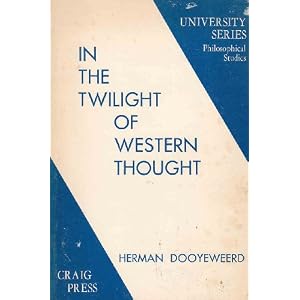
In the Twilight of Western Thought may be the best book to read to begin working through Dooyeweerd's teachings.  The book grew out of the lectures he gave here in 1959.  To the surprise of some people, the introduction to the original editions book was written by R. J. Rushdoony. The book was published by Craig Press, which was a name used by Presbyterian and Reformed Publishing Company for many of their books directed toward university audiences.  As Rushdoony noted in his fine opening, Dooyeweerd's thought "gives important and exciting direction to present and future thought, and is, in the fullest sense of the word a Christian philosophy and a great one."


Craig Press also published Dooyeweerd's lecture titled The Christian Idea of the State.  Dooyeweerd was presenting Christian political thought in a world gone mad with atheistic, totalitarian, and evil political forces.  He gave the original lecture in 1936 to a group of Dutch youth who were affiliated with the Anti-Revolutionary Party of the Netherlands. It was a time when the ideologies of socialism, fascism, communism, and the like were in the ascendancy.  No doubt, many of the students who listened to this lecture in 1936, found themselves in the danger zone just a few years later when the Nazis occupied the Netherlands.  Dooyeweerd himself had to spend many of those years in hiding from the Gestapo.

The Mellon Press editions of Dooyeweerd's works are extremely well done, but are expensive.


Thursday, March 10, 2011

Facts

“The truth escapes us not because we do not know enough facts,
but because the relationships of the facts are so complicated.”
E. Harrison Harbison, Historian


"Upon this gifted age, in its dark hour,
Rains from the sky a meteoric shower
Of facts…they lie unquestioned, uncombined.
Wisdom enough to leech us of our ill
Is daily spun; but there exists no loom
To weave it into fabric."
Edna St. Vincent Millay, Poet

Thursday, March 03, 2011

Enlightened Readings about the 18th and early 19th Centuries

One of the great joys of my job is getting to read great books and discuss them with the students. In recent weeks, we have been reading Jane Austen's delightful book Pride and Prejudice.  Given just a bit more time and only a small nudge, and I could become a Jane Austen addict.  The first time I read the book, some years back, I thought it was a good book.  The second time was four years ago, and it was then that I discovered something of Austen's comic voice.  This third reading has revealed much more of the depth, the artistic unfolding, the understatement and subtlety, and brilliance of the book.  The class and I have delighted in watching the relationships in the novel develop right alongside our ability to learn analogically (as Dr. Cowan says we should).


Enhancing my understanding of Jane Austen and Pride and Prejudice is Peter Leithart's book Miniatures and Morals: The Christian Novels of Jane Austen.  I need another half dozen books about Austen's life and techniques, but I don't know that I will ever find a book that is better than Leithart's work.  I wouldn't want to tach Jane Austen without it.

Since our Humanities class covers history and literature, we are often moving from one subject to the next.  When we get to Les Miserables next week, there will be plenty in that book to tie in with events going on in France from the Revolution through Napoleon and on up to the Revolution of 1848.  Jane Austen amazingly almost never refers to anything going on in the political world during the time of her novels.  Although we try to get a sense of the greater events in all of Europe, it is often easier to see history through the lens of one country.  My students and I have loved the Simon Schama video series, A History of Britain.   I also make use of the accompanying books. The second volume covers events from the time of the death of Queen Elizabeth (1603) and the reign of the Stuart monarchs through the revolt of the colonies in North America.  Schama has become one of my favorite historians.


I love big, bulky, wordy, thick, heavy history textbooks.  The book pictured below, A History of the Modern World by R.R. Palmer and Joel Colton (8th edition), has become a favorite reference source of mine.  If I were isolated on a desert island with only 837 books, I would want this to be one of them.  The pictures and graphics are few, but the writing is quite good. 


The book pictured below is the latest (10th) edition of A History of the Modern World.   A third author, Lloyd Kramer was added to some of the later editions. This newer edition, which I just received, appears to have a few more helps and graphics in it, but it also retains the integrity of the earlier texts.  Often I am suspicious when there are too many "improvements" in the editions of a book.


Since our studies have been on the time of the Enlightenment (the 1700s), I have been reading from Building a Bridge to the Eighteenth Century by Neil Postman.  So far, and I have read some of the beginning portions of the book, this book appears to be very favorable to the ideas and developments of the Enlightenment.  Traditional conservative and Christian interpretations of the Enlightenment are critical and tend to focus on the more negative results of the movement.  Certainly there is enough about the Enlightenment to raise our objections, but it is good to read a defense of the movement as well.


Bradford Pear Blossoms


Winter’s last and only certain snow
Banks the pear branches white with blooms,
Trumpeting royalty to follow
On flowered grass from earthly looms.

Bare limbs hopeful with clutches of flowers
Dance like bridesmaids before the sun,
In rhythm to the tune of showers
As birds sing that winter is done.

As buds melt the last snow into green,
Warm sirens draw us out to the trees,
Seeking a corner of grace to glean,
Like the repentant heart trying to please.

Appearing in air from the cold;
On pear branches, drifts bank and grow,
As the chilled hand lets loose its hold:
Winter’s last and only certain snow.

I think my children would be disappointed if I did not post this poem on the blog this time of year.  The poem's opening line originally read "The South's last and only certain snow."  It is not true of all the South, but the area where we live often has no snow in winter.  On other occasions in the past, we might have a day of snow.  Sometimes the snow would fall in the morning hours and be nearly all gone by evening.  But this year, we have three ground covering snows.  Over the last several days, this "last and only certain snow" has appeared all around us as Bradford pear trees are decked out with white flowers.  The particular variety of Bradford pear trees in this area do not produce fruit.  Just today I noticed that our fruit bearing pear trees are blossoming.  The ground areas are also covered with small white flowers.  Seasonal changes never cease to amaze me.