|
| General Washington opts for retirement from the military rather than assuming the rule over the new nation. |
American politics boils down to one simple rule: Let’s vote on it. Once General George Washington surrendered his sword to the president of the Continental Congress, he relinquished the opportunity to be King George IV of the Americas. The process was then continued that began cementing this principle of “Let’s vote on it.”
In voting, power is in numbers. Basically put, the majority wins and the minority loses. The losers have the option of saying, “I told you so,” if the proposition fails. That is often all the loser can hope for. Going home with all the marbles, a.k.a. winning, is much better.
As anyone knows who has ever been in the middle of a group of church women deciding on the new color for the fellowship hall, the world does not consist of those who favor green and those who favor yellow. That's why the paint store offers over 200 shades of white. Add all the other colors and shades in and the process of picking a single color for a wall becomes impossible.
From this it follows that coalitions are necessary for all of life. Those who are generally in favor of some “creamy buttery color that is not too yellow” unite around a swatch of paint against those who favor “a greenish tint with a hint of blue.” The majority wins and the paint rollers take over. The losing faction either accedes (“It does look good.”) or whines (“I hate this color: It looks like pork skins.) or they start a new church (the American Protestant answer to almost every theological problem).
In any political contest, there are always a variety of factions and views. James Madison’s Federalist Number 10 is the primary source reading for this fact. Any political victory consists of uniting a number of people and groups with different visions around a common theme. Quite often, the defining and uniting point is “Throw the bums out.” We may not be happy with the “bums” we are backing who will replace the bums currently in office, but at least they will be new and different bums. The main motivation becomes getting the current administration of the city, state, or nation out of office. A key example of this was the uniting of various anti-Andrew Jackson factions who formed the hapless Whig Party back in the 1820s.
Franklin Delano Roosevelt and Ronald Reagan were the two greatest coalition builders in American twentieth century history. Both men had definite and deeply held convictions that appealed to small dedicated groups. FDR was a political liberal at heart and RR was a political conservative at heart. FDR was not interested in merely the applause of the powerbrokers at Tammany Hall in New York. RR was not interested in merely the applause of subscribers to
National Review and
Human Events.
The Reagan coalition began with die-hard conservatives. Most of the heroes and guides to the conservative movement were speakers and writers, like William F. Buckley or Russell Kirk. Most of their political heroes held congressional seats or maybe a Senate seat. People with a cause rally around lone voices in the wilderness. Those causes await someone who can move the operation from the wilderness to the city, particularly, the suburbs. Reagan was a great speaker to conservative causes, but he was able to go beyond the small groups, beyond the wilderness. After all, he governed California for 8 years.
Reagan’s appeal went past the ideological conservatives to the voter rich Southern white Democrat base. Sons whose fathers voted for and fought overseas for FDR became a part of the Reagan coalition. In 1984, Walter Mondale sanctimoniously chided President Reagan for appearing with Minnie Pearl on the Grand Ole Opry. In Mondale’s skewed vision, Reagan should have been more interested in meeting with the leaders of the Soviet Union. But the Grand Ole Opry represents a wide swath of working class Americans, and the late Minnie Pearl’s embrace was more vital than the then dying-off old Stalin junta that ruled in Moscow.
Reagan also appealed to folks whose lives were centered around Wall Street and whose reading was dominated by the
Wall Street Journal. (In the 1980 campaign, the stock market diped suddenly when a rumor surfaced that Reagan had suffered a heart attack.) He also appealed to blue collar factory workers in the north. RR appealed to folks living in the suburbs whose fathers and mothers came from Italy, from Ireland, and from other eastern and southern parts of Europe. Military people liked Reagan’s views of defense. Factory workers liked his views of work and taxes. Old time liberal and frequent Democrat Presidential candidate Eugene McCarthy endorsed Reagan in 1980. The Rev. Ralph Abernathy and other prominent black leaders also endorsed Reagan.
Reagan united Republicans (many of whom only reluctantly acquiesced to his nomination), attracted large numbers of independents, and swiped whole sections of the old Roosevelt coalition into the Republican column. The results were great landslide victories at the Presidential level in 1980, 1984, and 1988 (when VP George H. W. Bush won) and a further sweep in 1996 when the Republicans captured the House and Senate, in part due to Newt Gingrich and others reciting Reagan mantras.
Reagan’s political legacy includes successful coalition building. You see the same with FDR. You see the same with Lyndon Johnson, particularly in his mastery of the Senate during the 1950s. (Read Robert Caro’s excellent series on Johnson, particularly, volume 3
The Years of Lyndon Johnson: Master of the Senate.)
Life in a Democrat Dominated State
I first started voting in Arkansas in 1982. Prior to that, my voter registration was in Texas. Texas was already well on its way to becoming a predominantly Republican state in terms of Presidential races, election of governors, and the election of the two Senators and many congressional districts. At the more local levels, Texas was still a one-party state. Even more so, Arkansas was far more Democrat than Republican.
In Arkansas, to win as a Republican, you often had to run as a Democrat. Or you could wait for just the right time when a Democrat office holder had blundered, gotten caught, and paid the price at the polls. Hence, Governor Bill Clinton (Democrat) was elected in 1978, and due to raising the price of car tags and a few other blunders, he lost his re-election bid in 1980 to Republican Frank White. Clinton repented of political errors and won back the governorship which he held until he and Hillary moved to Pennsylvania Avenue in 1993.
There was little to be gained by hoisting the flags of conservatism, economic freedom, guns, prayer in school, national defense, and anti-Communism and other social issues as a Republican running against a Democrat in Arkansas. Even the “liberals” in Arkansas were “conservatives.” (Realize, however, that many Arkansas Democrats abandoned Arkansas values while serving in Washington.) In Yellow Dog Democrat Arkansas, even the Republicans were Democrats. The Democrat Primary, usually held in the spring, throughout the South was “the election” for most voters on all state and local officeholders up until a few years ago.
Now look at Massachusetts. In Massachusetts, to win as a Republican, you often had to run as a Democrat. Some of the “more conservative” political candidates in Massachusetts would have been to the far left of Sen. William Fulbright, Governor Winthrop Rockefeller, Governor and later Senator Dale Bumpers, Governor and later Senator David Pryor, and Governor and later President Bill Clinton, all of Arkansas. Massachusetts was not as one-party dominated as Arkansas, but it favored Democrat candidates.
Hence, independent Mitt Romney supported Democrat Paul Tsongas of Massachusetts for President in 1992. If Romney had been living in Arkansas and had been running a chicken business, he would likely have been supporting Gov. Clinton. (I was voting in Democrat primaries in Arkansas and even considered a political career as a Democrat, of the old Southern Jeffersonian variety. Now such Democrats are extinct.)
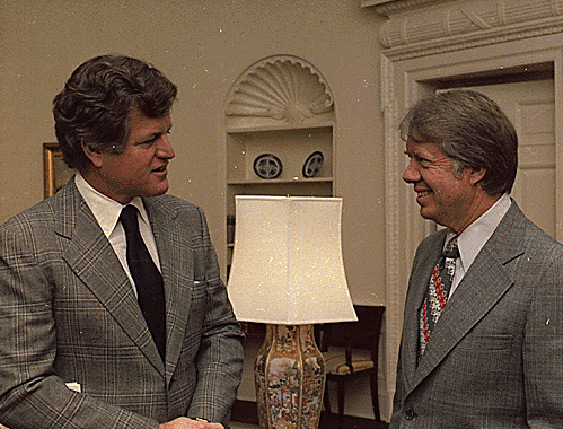
Mitt Romney decided to enter politics in 1994. Being a Romney, he didn’t decide to run for city council or a position as state representative. He decided to take on something bigger even than the Presidency at that point. He ran against a Kennedy in Massachusetts. Not just any Kennedy, but Sen. Ted Kennedy, the heir of the Kennedy fame and name, the Lion of the Senate, the last surviving brother. But Kennedy had some extra baggage (besides that surrounding his waist), besides the ever-ignored Chappaquidick problem. He had been involved in trashy legal case regarding his nephew in Florida. Senator Kennedy was vulnerable in 1994.
 |
| Sen. Kennedy defends his seat against the challenger, Mitt Romney, in 1998. |
Romney had at least 2 motivations to opt for the Republican Party. One was his own name and fame. His father, George Romney, was a big name in Republican history and politics of the 1960s. George Romney was a successful business man in the auto industry in Michigan, a popular governor in Michigan, a Presidential candidate in 1968, and a cabinet member in the Nixon Administration. Republicans with a memory would be favorably inclined to the Romney name.
The other motivation was this: Running in the Democrat primary against even a vulnerable Sen. Kennedy was insane. Politics is about winning.
Romney took on the giant political leader of Massachusetts and lost. He lost big. Kennedy won 58 percent of the vote, but for a time, the race was tight and Kennedy’s margin of victory was the smallest ever. One can argue effectively that Romney ran to the right of Kennedy or that he ran as a liberal. It’s Massachusetts, not Arkansas.
It would be a while before Romney, now a household name, would enter Massachusetts politics again. And time would enable him to improve his campaigning and image. Being a rich, well educated, proper gentleman, he had to start coming across as an ordinary guy. (This has always been a challenge for Romney: He is not ordinary.)
From 1990 to 2006, Massachusetts had a series of four Republican governors. Because of the nature of American politics, the fickleness of voters, the vagaries of life in a fallen world, and the nature of political coalitions, no one party tends to hold power completely or forever in a state. If a state has a single dominant party, that party then divides between factions. (In Arkansas, that meant that Democrat Dale Bumpers was able to win the Democrat nomination for governor over Orval Faubus.) Massachusetts Republican Governors William Weld (elected in 1990 and 1994) and Paul Cellucci (elected in 1998) both resigned from their governorships to take other appointments. Cellucci was succeed by Lt. Governor Jane Swift, whose short lived administration was noted for her giving birth to twins and her own political incompetence.
Mitt Romney then took he second plunge into politics in 2002, running for governor of Massachusetts. He won, he ruled, and in 2006, he left the office. By 2006, Massachusetts had enjoyed 16 years of respite from the years of Michael Dukakis. In the political pendulum, it was probably a wise choice for Romney to leave office. The political trend favored a return of that state government to the Democrats. Besides, Romney now had bigger fish to fry anyway. He had inherited a political name and fortune. He had twice taken on great political races and had won the last race. He had made his own fortune with Bain Capital (the envy of his opponents). He had taken on the task of salvaging and running the 2002 Winter Olympics in Utah. So, in 2006, what was left for this politically young man to do?
 |
| Sen. Fred Thompson, Gov. Romney, Sen. McCain, Gov. Huckabee, Mayor Guliani, Cong. Paul: Candidates in 2008 |
Mitt Romney for the Republican nomination for President in 2008. I supported former Arkansas Governor Mike Huckabee that year. I wish he had won the nomination. I thought Fred Thompson might be a good candidate, but he fizzled. Governor Rudy Gulliani was a competent leader, but too far to the left, too challenged by marriage and family matters, and was a disaster as a national candidate.
Much of the attention in Republican circles in 2008 centered around Romney and Senator John McCain. For reasons inexplicable, Republicans often feel obliged to nominating someone who cannot speak, debate, articulate a vision, or convince an independent to vote for them. Duller than Bob Dole, less articulate than George H. W. Bush, with less charisma than Alf Landon, John McCain won the nomination over Romney and Huckabee. For the oddest of reasons, the conservative leaders flocked to Romney during the primary season, but the Republican establishment felt more comfort with McCain.
In retrospect, Romney would have been a much better Republican candidate than McCain in 2008. When the market troubles erupted in October, Romney could have offered some alternative to “Hope and Change” by appealing to his being a political outsider to Washington and his business experience. McCain was a weak candidate. His Vice Presidential candidate, Governor Sarah Palin, was a jolt of fresh energy on the campaign trail. With a resume so weak that only Sen. Barack Obama could have envied it, she only managed to give a good nomination speech, thrash Joe Biden in a debate, and blunder some key interviews. She did draw bigger crowds than John McCain. But then again, Bob Dylan singing opera would have drawn bigger crowds than McCain and the Dylan concert would have been easy to listen to than the repeated “My friends…” of the McCain litany.
Romney's campaign for the 2012 Republican nomination officially began when the electoral votes started piling up for Obama in November of 2008. Republicans like reconnecting with their jilted candidates. New faces don’t win the nomination very often for Republicans.
So, Nixon was a national candidate from 1952 to 1972.
Reagan ran for the nomination in 1968, 1976, 1980, and 1984.
A Bush family member was in the running in 1980, 1984, 1988, 2000, 2004, and could have been a player in 2012.
A Dole family member was a national figure in 1976, 1980, 1988, 1996, and 2000 (Sen. Elizabeth Dole).
McCain ran in both 2000 and 2008.
So, Romney knew that victory in the nomination process comes to those with perseverance. With runs by the Romney family in 1968 and 2004, he knew he had lots of advantages going into 2012.
[Readers of this blog also need to persevere. Based on the hundreds of comments this series has produced and the number of other bloggers linking to it, the world is awaiting the conclusion.]