Tuesday, November 27, 2012

History for Christmas, Gift Ideas

I live in denial.  "There are no history books that I want for Christmas.  And I have too many that I still need to read. So, no books on history for me.  Really."  But it is not true.  I discovered just a few days ago that someone had finished writing the third volume of the Churchill biography that William Manchester never completed.  How can I live without that?  And Jon Meacham, who wrote a good biography of Andrew Jackson a few years back, now has a book about Thomas Jefferson.  AND, Peter Ackroyd has written the first in a series of books on English history.  It is titled Foundations:  The History of England from Its Earliest Beginnings to the Tudors.

But enough about me and my impoverished book shelves.  What can you get for the historian in your life?  I am tempted to refer back to the 100 greatest books on non-fiction that I posted many moons ago.  Also, I have many blogs from days past that list books.  But I will confine myself to a few new selections.


John Locke:  Another Influence on the Founders
 In my Modern World Humanities class, I teach about the four world-changing revolutions.  They were the Glorious Revolution in England in 1688, the American Revolution of 1776, the French Revolution of 1789, and the Russian Revolution of 1917.  The first two were radically different from that last two.  And the first two were inspired in large part by the thinking and writing of John Locke.  Most Americans are familiar with Locke indirectly through Thomas Jefferson's writing of the Declaration of Independence.  Locke's Two Treatises of Government are a classics in political philosophy.

Christians interested in politics, and that should be all Christians, should rejoice in the book John Locke: Philosopher of American Liberty by Mary-Elaine Swanson.  This work was among the last labors of Mary-Elaine Swanson.  Her works go back to a time when Christians started rediscovering the forgotten Christian influences in history.  Christians began realizing that they could actually teach their own children and teach them a different perspective.  But what was that perspective?  That were plenty of oversimplications and distortions.  Puritans were bad and the Founding Fathers were secularists (or maybe Deists).  Books started being published, old sources started being rediscovered, and books from the past started getting reprinted.  This movement was propelled by such people as Peter Marshall Jr., Paul Jehle, Marshall Foster, Verna Hall, Rosalie Slater, and Mary Swanson.

Today, a Christian can fill quite a few book shelves with both scholarly and popular historical works dealing with the Christian figures, movements, and influences on American history.  I know that from personal experience.  Of course, Locke is not an American, but he was widely read by the Founding Fathers. 
One of the books I use in my government class is John Eidsmoe's Christianity and the Constitution.  One of the best features of that book is the chapter that deals with some of the key thinkers who influenced the Founders.  And of course, Locke tops the list. 

Thanks to my friends at Nordskog Publishing for making this book available.


Bullinger:  A peer to Calvin and Luther
Maybe I recommended this book last year, but it is worthy of highlighting again.  Henry Bullinger: Shepherd of the Churches by George M. Ella.  This book is valuable simply to help us all to see that God did not just raise up Luther and Calvin in the 1500s.  There were quite a few other key theologians and pastors who spoke and wrote just as boldly and with the same convictions as Luther and Calvin.  People still read Luther's Bondage of the Will and Calvin's Institutes.  (Or at least, they buy the books to put on the shelves or recognize the titles.)  Martin Bucer, Philip Melancthon, Henry Bullinger, and quite a few other Reformers appear as almost footnotes or shadow figures.  Some readers might think that this biography overstates Bullinger's importance.  And those of us who have identified ourselves as Calvinists for years would find it stressful to now have to call ourselves Bullingerists.  Nevertheless, this book is a necessity for Reformed pastors and history teachers.

I am thankful to my friend David Leach for calling my attention to George Ella's writings.  David is an excellent bookman with a vast awareness of many authors and titles.  I have bought many, many books from him through the years. Having gotten acquainted with the author and this book, I would love to acquire quite a few more of Ella's books.   The only problem with this biography of Bullinger is that it is published in England.  That boat trip across the pond hikes the price of such books.  This book, along with some of George Ella's other titles, are published by Go Publications.

I have more history suggestions for later.

Sunday, November 25, 2012

Philosophy for Christmas, Gift Ideas

Books make good decorations for the tree, but are better used as gifts.

I collect books on philosophy and start books on philosophy and intend to read books on philosophy.  Occasionally, I finish a book.  I honestly believe that philosophy is not my field, gift, inclination, or calling.  Yet, as a history and literature teacher and as a pastor and teacher in the church, I cannot ignore the field. 
I have managed to read some philosophical works this past year.  In my Humanities class last spring, we read Plato's Republic.  It was a good and overdue read for me.  And this past month, I read and taught through about half of Augustine's City of God.  More recently, I read a short book called Philosophy and Theology by John D. Caputo.  This is an 84 page study that calls for another and a closer reading.  It was set right about at the level I needed.  It would do for your Christmas list.

Short and witty introduction to a key topic.
Here are a couple of more suggestions for the philosopher in your life:

Another useful book that helps unlock the thinking of Herman Dooyeweerd.

A few years back, I was working on a lecture series called "Calvinistic Worldview Thinkers in the Wilderness Years."  One of the most important influences on Calvinist thinkers in the 20th century that I discovered was the Dutch philosopher Herman Dooyeweerd.  I began collecting books by Dooyeweerd and about his thinking.  At that time, many of the books on Reformational Philosophy were either out-of-print or expensive.  In the last several years, Paideia Press has been publishing books by Dooyeweerd and related thinkers at really affordable prices. 

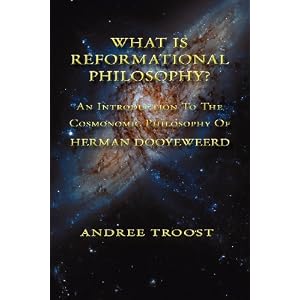
I have only been able to scan through a bit of What is Reformational Philosophy?  An Introduction to the Cosmonomic Philosophy of Herman Dooyeweerd by Andree Troost.  Still, I am glad to see this book available.  The back cover states, "If the busy student can read only one volume on Christian philosophy, this is preeminently the book to read."  I probably have 2 dozen books that are the "one volume a busy student should read"; nevertheless, this book is inviting.  I just wish I had talks and travel to places ranging from Virginia to Alaska so that I could justify spending time reading this book.  (List for $9.50 on Amazon--a steal!)

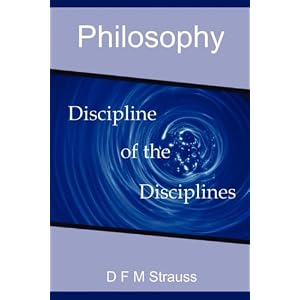
Besides the books by Dooyeweerd (and three more have been recently republished), Paideia Press began its ventures just a few year back by publishing a 700 plus page book titled Philosophy as the Discipline of Disciplines by South African scholar D.F.M. Strauss.  I am the proud owner of an inscribed autographed copy of this book.  This is not a beginner text.  But for the serious student who wants to pursue philosophy from a Christian viewpoint, this would be marvelous gift. And it is a 700 page book that sells for $15 from Amazon. 

Weighty

Dooyeweerd, Troost, and Strauss are all from the Reformational view of philosophy.  Or, we might say, they are in the Calvinist Protestant tradition.  I always feel a natural alliance with such men.  However, there are others who hold to different perspectives whose work I like.  One is the Catholic thinker Peter Kreeft.  I have read several of his books and have enjoyed teaching through Socrates Meets Jesus.  As far as a philosophical thinker excelling at providing introductions to beginning students (meaning, high school students, college freshmen and sophomore, or overaged people like me who are forever playing intellectual catch-up), Kreeft is quite good.

I have recently received a copy of Summa Philosophica by Peter Kreeft.  This book is published by St Augustine's Press and I would like to have every book they publish.  Let me note what the cover says about this book:  "Kreeft employs the medieval quaestio debate format so successfully employed by St. Thomas Aquinas in his Summa Theologiae.  This tour-de-force takes up 110 perennial questions asked through the centuries. Kreeft covers questions about metaphysics, knowledge, and ethics....If you want a summary of all the most important questions in philosophy, as well as the most convincing answers to these questions, this book is the single most reliable and enjoyable guide available." (Christopher Kaczor)

Summa Philosophica
Serious cover, deep thoughts, fun book.
To get a sense of how Kreeft himself writes, note this from inside the book: 
"Dear prospective reader,
If you are wondering whether this book is worth your time to read or your money to buy, don't read the long, dull Introduction first. Browse through the book itself."

I cannot imagine that Kreeft will be dull and I affirm that his books are worth the time and money.

Coming up next:  Books for the Historian in your life.

Friday, November 23, 2012

Books for Christmas, Part 1

Books require little or no external wrapping.  That is because books are wrappings.  In the book world, covers, especially paperback covers, are referred to as wraps.  The cover, whether an inviting work of art or a more stately solid color, is an invitation.  The cover itself is a gift.  It is art and definition and stability.  The spine, preferably gilded with the title and author's name, will quietly adorn the shelves, taking its place among its comrades.  Row upon row of books will silently remind you and inform listeners of wisdom, mortality, beauty, and the quest for story.  Every pause in every human conversation, every glance to the shelves during other ways of wiling away the hours, the spines speak.  Deep, silent, haunting, they are stationary in the midst of the passing hours and solid in the midst of the fluidity of life.


  Then consider the title, and if you, the reader are special, sub-title, of a book.  The title may inform you or it may intrigue you.  Sometimes, we need to know exactly where we are going.  We need the title that is the GPS to our thoughts.  At other times, we don't know "for whom the bell tolls" or how to be "surprised by joy."  The sub-title is the promise of the book to change your life or thinking in some way. Sometimes the sub-title reveals (and sales the book) and sometimes it conceals. 

 Then then there is the author.  Again, the name of the author is a gift.  I recently bought (you could almost say "stole") a beautiful three volume set of the works of John Bunyan.  It was his name that convinced me to purchase this gift for myself.  The author's name is the way the gift says, "Meet a new friend. You will enjoy getting to know this person."  If it is a familiar author, it says, "Hey, it is time we got back together and get caught up on what has been happening."  If it is a well known author, one whose books are deemed as classics, it says, "You have heard a lot about me, no doubt.  But I would like for you to know me for yourself."

All this only brings the reader to the opening of the book.  Each page or chapter invites the reader to stay longer, to relax, to put aside some minor distraction (like work or eating or sleeping), and to enjoy a little more conversation. As the pages begin to turn and as the story or thoughts develop, the reader begins to find the need for some accessories.  A chair, or pillows propped up on the bed, or a lamp, and a mute button on the surroundings.  Some books call for strong caffeine in the mornings to enhance the flavor, while others promise to help end the pressures of the day and cushion the hour leading up to (or delaying sleep).

The reading then progresses to that other beginning portion of the book--the last page.  A good book, the really good ones, only begin when the last word on the last page is read.  There are those books that are so impacting that it is a different person who puts the book down than the one who picked it up.  Not every book is a Damascus Road experience, but some are.  Most books are road experiences of some sort, whether the road is a pleasant country drive or an interstate highway easing the passage from one place in life to the next.  It has to be admitted that not every road is profitable, beneficial, or enjoyable.  And some roads are wrong roads.  Thankfully, no book has foreboding red signs in it saying, "No U-Turn."  You have some editorial privelege.  You can insert the words "The end" anywhere you wish. Yes, there are cases where the visit has been like a root canal, cases where yours and the author's time together ends with,  "It's been nice knowing you.  So long."  But in the better cases, the last page either invites the reader to race to the bookshelves for more books or, perhaps better, to turn the pages back over to the beginning, so as to relive the experience.

So, we will start sharing some gift ideas.  I will assume that the classics of literature, theology, and history are already on the lists.  I don't need to be a dull echo telling you to acquire the works of Augustine or Austen, of Dickens or Dostoevsky, or of William Shakespeare or William Faulkner.  Stay tuned. 

Wednesday, November 21, 2012

The Mormonizing of America

In humor, timing is everything.  Timing is important in pretty much every endeavor.  A three point shot made after the game is irrelevant.  During the game, it is a game changer.  Timing is critically important in when a book hits the market. 

Good popular history of a distinctly American religion.

The Mormonizing of America by Stephen Mansfield hit the market in July of this year.  Mitt Romney was awaiting the formal nomination as the Republican candidate and no one was sure how the political season would end.  Evangelicals had expressed great doubts over Romney's Mormonism.  But as the more acceptable candidates either faded, never appeared, or got knocked out of the running, conservative evangelical Republicans had to make a decision.  Election year 2012 was not exactly a "dream come true" time for the Religious Right holdovers, Tea Party supporters, or Puritans.

For many of us, the question regarding who to vote for or whether to vote got down to the stark alternatives.  I have grown weary with the "lesser of two evils' phrase and the various approaches people take to it.  It was simply a matter of competence.  I firmly believed that Mitt Romney could step into the Oval Office (or virtually any executive office) and quickly figure out what needed to be done.  I did not assume that I would like all that he did, but believed then and now that he would show great skill in taking on the task of executive leadership.

Mormonism became a side issue.  After all, the Democrat President is in no way an orthodox or evangelical Christian.  I will let others decide how to best define President Obama's theological convictions or lack thereof.

Stephen Mansfield's book will, no doubt, get quickly remaindered and discounted due to Mitt Romney's loss.  A Romney win would have at least raised the question of a revision with the addition of a chapter specifically devoted to how a Romney Presidency would impact our culture.

But this book need not be pushed over into the discount bin and be disregarded.  The subtitle states, "How the Mormon Religion Became a Dominant Force in Politics, Entertainment, and Pop Culture."  The "Mormon Moment" that the book describes has not yet passed.  The history of the movement and the theology of the LDS church is still rather unknown to most people.

Undiscerning Christians and the people who routinely think all evangelicals are prejudiced nitwits will easily buy into a certain viewpoint toward Mormons.  After all, John F. Kennedy's Roman Catholicism was once an issue, but both VP candidates this year were Catholics.  Just as Protestants once voted for Kennedy, so evangelicals voted for Romney.  A Presidential candidate being a Mormon will not be questioned in the future.  And currently, the Senate Majority Leader Harry Reid is a Mormon, and his political problems don't stem from his religious convictions. 

But the statement made by Franklin Graham remains true:  Mitt Romney is not a Christian. He is a Mormon.  The same can be said for Glenn Beck, Harry Reid, and other prominent Mormons.  Christians and Mormons have some similar language and similar beliefs, but they are not the same. And these differences are not comparable to the differences between a Wesleyan Methodist and a Southern Baptist. In the past, Mormons were very adamant about defining themselves as different from all forms of traditional Christianity.  They do trend today toward defining themselves as just another denomination.  Re-defining their image has been a staple part of Mormon history.

Mansfield's book lays out the background to the movement.  We can call Mormon history weird and that is putting it lightly.  This book still calls for reading.  The movement still calls for some serious theological and historical evaluation.

Saturday, November 03, 2012

Great Hunting

It's November and so it is a great time for hunting.  Well, for me that means book hunting.  Today's hunt was unexpected.  A lady told me about an inside sale at the fair grounds.  It cost a buck to get in, and there were dozens of booths filled with all sorts of garage sale items and crafts.  I thought it would be an easy run through the place with nothing to find.

And then, I stumbled across this set:
The Works of John Bunyan
Three volumes...Banner of Truth....The Works of John Bunyan.
The price tag said $25 for the set or $10 per volume, but the lady running the booth said, "What about all 3 for five dollars." 
And they are in new condition. 
What a find! I would like to have everything Banner of Truth has ever published.  Their selections are always fine works in the Reformed and Puritan Traditions.  And their books are quality productions.
All in all, a good day of book buying.

All three volumes are quite large and the books are in perfect shape.