Tuesday, February 28, 2012

Literary Studies

"A classic is a book that has never finished saying what it has to say."  Italo Calvino

There are at least two great benefits to reading the classics.  Of course, the first is the pleasure of the books themselves.  I can remember the experiences of many classics.  The weaving through a Faulkner novel, the realization of the depth of Dostoevsky, the subtle humor of Jane Austen, the unsubtle humor of Mark Twain, the ache of the Iliad, the vastness of War and Peace.

The second benefit comes from the occasions where the books are discussed.  Even when there is a teacher, a first among equals, the work of literature is an unpacking, a quest, a savoring of meaning.  I don't have those opportunities anymore to take classes, to join serious reading groups.  But I do profit from reading; that is, reading about reading, or reading literary criticism or other types of books that discuss the great books.

Two books I have been digging into lately are Twentyfive Books That Shaped America by Thomas Foster and The Terrain of Comedy, edited by Louise Cowan.

Imagine having two great literature professors.  Dr. Foster, who also wrote How to Read Literature Like a Professor, is funny, challenging, biting in sarcasm, delightful in insight.  As the cover of his book proclaims, this study tells How White Whales, Green Lights, and Restless Spirits Forged Our National Identity.  I find myself amazed at the connections Foster makes in surveying American classics.  Sometimes I agree, occasionally I disagree, and always, I am entertained.  Just the titles of the chapters are worth the price of the book.  For example, the chapter on Moby Dick is titled "I've Been Working on the Whaleroad" and the one on Faulkner's Go Down, Moses is called "He Ain't Heavy, He's My Cousin.  I love this book and am committed to reading everything Foster writes.

Part of the fun is questioning Foster's 25 picks.

And now, for the second professor:  Dr. Louise Cowan edited The Terrain of Comedy and wrote the introductory essay.  The contributors who wrote on different authors are the scholars who studied under Dr. Cowan.  Whereas Foster is fun, Dr. Cowan is deep.  Where he uses wit to make a point, Dr. Cowan uses care to write a sentence that requires several readings.  Where Foster pushes the delight of literature to great heights, Dr. Cowan and her colleagues dig deep into the depth of literary studies.

The Terrain of Comedy is a part of a quartet of literary studies published by Dallas Institute of Humanities and Culture.  In her introductory essay, Dr. Cowan explains her theory of literary genres. The ten essays then apply aspects of her theory to major literary works in the West, ranging from Homer to Faulkner. This book has just recently been reprinted and sells for $16.

Serious essays about comedy.

The other books in this series include the foundational volume on epic literature. It is titled The Epic Cosmos, and it includes Dr. Cowan's essay "Epic as Cosmopoesis," which is one of the most mind changing and mind challenging things I have ever read. A third volume is The Tragic Abyss. The fourth volume, which has yet to be completed and published, will be on lyric or poetry.


These books in this series can be purchased, along with other helpful literary works, from the Dallas Institute. For anyone in the field of literature not yet familiar with Dr. Louis Cowan, I would recommend that they acquire An Invitation to the Classics, edited by Dr. Cowan and Os Guinness.

Friday, February 24, 2012

Great Reads of 2011--Fiction

I love reading novels.  Quite often my job entails taking my students through one of the great works of literature ranging from Walter Scott to Ernest Hemingway, from Charles Dickens to William Faulkner.  Of late, I have tried to read a few more contemporary fiction writers.  This is risky business.  One does not want to fall into chronological snobbery and assume that only the authors of the past are good, and yet there are questions about the staying power of a current author.  The answer is balance.  As is often the case, read at least one author off of the approved list of great writers for every modern.  I actually pay no attention to that rule.

The nine volumes of the Mitford series:  Christian community in the real world.

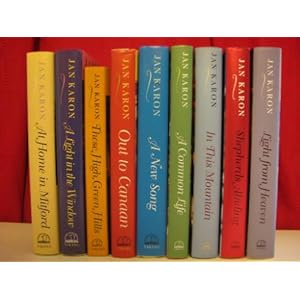
In This Mountain and Light from Heaven by Jan Karon
Jan Karon created a fictional world of Mitford with an aging Episcopalian priest named Father Tim.  My wife, mother-in-law, and sister-in-law all read the series several years back.  Stephanie would be reading and would stop and say, "He sounds exactly like you" and then laugh about it.  It took me a while to get into the series.  I generally saved these books for down times, for they are easy and relaxing reads.
Karon created a very delightful community with lots of things to remind us of the importance of the church family and the village.  I can hardly remember the plot of one book from the next. I think there are 8 books in the series.  Still, these were fine stories.
This is the 1833 Benchley edition of Austen's works.  No, I don't have it.

Pride and Prejudice by Jane Austen
Miss Austen keeps improving.  It helped that I had a class that fell into the story.  We had some great times pulling ideas out of the developing plot.  I would enjoy a group read of all the Austen series.

Les Miserables by Victor Hugo
Grand and sweeping book; a page turner. The Liam Neilson movie adaptation is good also, but still, one has to fall into the greatness of the book itself.  It is hard to find a book that better illustrates and is better rested on Christianity, yet Hugo himself was not a good man.  It also helps that my classes have usually loved this book.  Much of the pleasure of a novel is having a company of fellow readers.


A good collection.
The Best Christian Short Stories, edited by Bret Lott
Really fine short stories by modern Christian authors. Lott’s introduction is worth the price of the book. This book introduced me to some modern Christian writers.  Christians may not be dominating the field of writing, but they have a presence.  And I am not talking about Christian writing that is sappy and sentimental.

The Brothers Karamazov by Fyodor Dostoevsky
I think that this was my fourth complete reading of this book. This is really too much book for most high schoolers, but I was pleasantly surprised at some who got it.  I need to get more deeply into Russian literature.  Dostoevsky has several books that I need to re-read or complete.

A Song I Knew By Heart by Bret Lott
This book is a retelling of the Book of Ruth, set in modern America. Lott strongly emphasizes forgiveness in his books.  He is one of the best contemporary novelists and one of the best Christian novelists around.  My son Nick got to meet him last fall.
This is more than a formulaic western.
True Grit by Charles Portis
Prior to watching the new version of the movie (which I loved), I read this novel.  It was great.  The girl in the story was a fiery Presbyterian. 

Light in August by William Faulkner
Read in August and was first read back in college. Disturbing and rich. Man’s alienation and brokenness. Of course, I followed this book with some reading from Cleanth Brooks.  This is not a "sit back, relax, and read" book.  The plot and the style are both quite a challenge.  Every summer I try to read or re-read a book from the Faulkner corpus.


Saint Maybe by Anne Tyler
I watched a Hallmark movie of this story some years back. The book is quite good. I would be interested in reading more works by this author.  I don't think Tyler is a Christian writer, but this story was built around a Christian theme and the main character was a Christian. 

Bleachers by John Grisham
A fine story and an enjoyable book. It brings out the idolatry so often found in sports, and yet there are benefits to the discipline and drive. And people need forgiveness.

[Let me know of any novelists who you enjoyed.  I am at a loss when it comes to the modern writers.]

Wednesday, February 22, 2012

New for Me on the Book Shelf

Thanks to a Canadian who bought a case of my books, I was able to order a set of books by a Dutchman from a publisher in England.  What an amazing global transaction.  This beautiful set of books is on sale from Piquant Press.  It took them a month to cross the pond, but they are now sitting on my table, luring me into the wonderful mind and writings of H.R. Rookmaaker.

A Christian who became an art critic:  H.R. Rookmaaker
Many people know of Rookmaaker through his friendship with Francis Schaeffer.  His best known book is Modern Art and the Death of a Culture. That book, along with a number of essays, makes up volume 5 of the set. 

Rookmaaker was converted to Christianity while being held a prisoner of the Germans during World War II.  His "second conversion" came when a fellow prisoner introduced him to the works of Dutch Christian philosopher Herman Dooyeweerd.  After the war, Rookmaaker chose the field of art because he felt that someone in the faith needed to address that area of life. 

Rookmaaker, writer, scholar, teacher, art critic.

Sunday, February 19, 2012

Great Books Read in 2011--Soul Nurture

This past year was a spiritual maze of valleys connected to valleys.  I went through quite a few trials and tribulations.  Most of the troubles related to seeing friends dying and experiencing changes in church and my church involvement.  For the third time since it was founded, my church, Grace Covenant, had a change in the leadership so that I became the primary pastor.  I am a teaching elder and have often been more of a side-line participant in the leadership.  But once again, I am on the starting line-up.

No one is adequate.  No one has the human gifts necessary, much less the spiritual qualities.  Christ's power, however, is made perfect in weakness.  I know that from Scripture and it is confirmed in my own ministry.  One of several great benefits of this calling has been the renewed and INTENSIFIED  reading of Christian books.  I have been reading serious Christian books for about forty years, but during times of challenge, change, and chaos, the reading is not leisurely done or done for enjoying a theological jaunt through Reformation Gardens.  Christian reading is survival for me. 

Here are some of the books I really enjoyed, grew from, and found formative:

Francis Schaeffer: An Authentic Life by Colin Duriez and Francis Schaeffer Trilogy.
I know I have beat the Schaeffer drum frequently in the past year.  What I LOVE about Schaeffer is that he was solidly teaching a Christian World and Life View (paralleling what I do at Veritas Academy), and he was teaching a life of holiness, personal devotion to Christ, and Christian living in the family (paralleling what I need to be preaching).  I am still longing to emulate Dr. Schaeffer in his gifts of hospitality and mentoring.  To paraphrase Flannery O'Connor, I would be a good man if I had someone reading Francis Schaeffer to me every minute of my life.

R.C. Sproul is a gift from God to His people.
Acts by R. C. Sproul
This is a part of Sproul’s commentary-sermon series. Good study that is brief and balanced with doctrine and application. This book easily lends itself to a morning reading time.  I hope to someday preach through the Book of Acts, and I will plunder this work for helps.

The Call by Os Guinness
This was March’s morning spiritual reading. And this was my second year to read this book. Os Guinness studied at L'Abri under Francis Schaeffer.  This book is rich in literary style and content and always has a strong punch with the affirmation that Jesus of Nazareth is calling us:  Listen to Him.  My son Nick also read this book and enjoyed it

Spiritual Disciplines?  Scary.  Essential.

Spiritual Disciplines for the Christian Life by Donald Whitney
If only I could apply as well as read books like this.  I bought it because J. I Packer endorsed it (along with about a million other good books).  Why did I not discover this book years ago?  I am realizing that I am going to have to read this book again and try harder at implement the disciplines. (By the way, I bought this book at GoodWill.  Praise God for great book finds.)

The Legacy of the King James Bible by Leland Ryken
An incredibly enjoyable, instructive, and delightful book. Worthy for the 400 year celebration of a masterpiece of translation. This book is a great collection of historical events and literary insights.  Even for someone like myself who does not normally read the King James Bible (except for my morning Psalm reading), Christians in the English speaking world need to know about the impact of the KJV.  Loved this book and loved meeting the author (Nick's lit teacher) this past summer.

Think by John Piper
Read this book twice. More focus on the Bible rather than on logic or reading skills. This book convinced me that I need to read much more by John Piper.  I have only just begun.  This book would be great for a group study.

My copy is a hardcover with no dust jacket.  The content, however, offsets the bland look.
Soul Survivor by Philip Yancey
The subtitle sold the book for me:  How My Faith Survived The Church.  At the time I stumbled upon a used hardback copy of this book, I was drawn in because he dealt with Dostoevsky and with disillusionment with church.  Christ's church is hard to love.  This book helped me through some tough times.Not all of Yancey’s heroes are my heroes; too often, his writing is too introspective; yet, this book is full of lots of good stories, enticing accounts of authors, and spiritual help.


Family Driven Faith by Voddie Baucham
Heard Baucham speak at the Atlanta ACCS conference in June. This is a hard-hitting book about the Christian family.  Every church should have a stack of these ready to distribute.  I need to read it again and again.

Sounded too familiar.

Letters to a Young Calvinist: An Introduction to the Reformed Tradition by James K. A. Smith
This book was fun and far-reaching book. It brought back many memories, good and bad.  I hope to teach this book to our young people, including my own bairns.

This book improved with age.

Between Two Worlds: The Art of Preaching in the Twentieth Century by John R. W. Stott
I first read this back in 1994. It was incredibly helpful to me this past summer. I need to read this book every year or two.  Dr. Stott went to heaven this past year, and I am determinied to read more and more of his books.

Preaching the Word--a great series.

Ecclesiastes: Why Everything Matters by Philip Graham Ryken
A great series, a useful commentary, but more so, good practical Christian application and a model for sermons.  This book is a collection of sermons.  I not only learned lots about Ecclesiastes, but I felt I learned a lot about sermon structure and content.

What a blessing to read.

King’s Cross: The Story of the World in the Life of Jesus by Tim Keller
I used this book for my personal Advent study.  It fit nicely into my morning devotional reading and theological study. This is how preaching should be.  If I had only read one book this past year, this would have been a good one

The Gospel present simply with literary references.

Epic by John Eldredge
Short evangelistic work. Built around themes of popular literature and movies. Good Lewis-style Gospel introduction.  I need a stack of these books and a crowd to hand them out to.  I have picked up a few more of Eldredge's books since reading this one.

Liberating the Laity: Equipping All The Saints for Ministry by R. Paul Stevens
A used, slightly worn paperback book found at Goodwill. A powerful read, stunned my senses. We have lots of church work to do; lots of thinking to change; lots of equipping needed.  I loved this book and wish that it were still in print.

Reader Take Note:
The books by and about Schaeffer, Acts by Sproul, Think by Piper, Family Driven Faith by Baucham, and the books by Leland and Philip Graham Ryken (father and son) are all Crossway Books publications. 
Crossway, along with IVP, Presbyterian and Reformed, and Banner of Truth, are among the best Christian publishers around.

Thursday, February 16, 2012

Great Reads of 2011--Biographies and Autobiographies

I am slowly getting around to my Best Books of 2011.  As a preliminary, I will be listing some of the best books I read in particular areas.  These will be what I call "Good Reads."  Some titles may appear more than once.  They are not ranked in order.

The first category is Biographies and Autobiographies

One of the most influential Christians of the 20th Century


Francis Schaeffer: An Authentic Life by Colin Duriez
This is a well done short biography of a great man.  I read it in 2010 to prepare my thoughts for the 100th birthday of Schaeffer this past January.  Schaeffer's life and work made me question my own life.  He has long been a good influence:  I wish he had been an even bigger influence.

Cash: The Autobiography of Johnny Cash with Patrick Carr
The Man in Black rambled a lot in this book.  I read a much better biography some years back, but it was still enjoyable to "hear him speak" in this autobiography.  Cash's life was a series of successes and failures, thankfully overarched with God's saving grace.  Cash left us lots of riches to enjoy.

I read the first volume of this trilogy right after I finished college.
Colonel Roosevelt by Edmund Morris
A Christmas present in 2009, a great read in 2010.  This was the final volume of the outstanding trilogy that I began reading in 1979. TR was a powerful figure through all his days.  This book deals with his last dozen or so (event filled) years.

An extraordinary writer and teacher.  Wish I had met him.

Jesse Stuart: An Extraordinary Life by Gifford and Kazee April
Some of the fiction Stuart created was based on his life story, and some of his life story was fictional.  He was quite a fascinating figure and a gifted writer.  This book is largely thematic and contains many pictures of Stuart and family and friends.


The Twilight of an Empire and the Dawn of Christendom
Constantine by Peter Leithart
This was not exactly a biography; more a defense and exploration of how Constantine’s baptized empire worked. Much of the book is an answer to pacifist John Yoder.  It answered lots of questions I had about Constantine--convincing.

Thanks to P&R for publishing a biography of a great thelogian.
 Herman Bavinck: Pastor, Churchman, Statesman, and Theologian by Ron Gleason
This lengthy book took a long time to work through. Many of the events and conflicts in Bavinck's life were obscure Dutch theological issues. This book reveals some of the flaws and characteristics in the life of the great Abraham Kuyper.  No one is perfect. I need more study now of Bavinck’s actual writings.

Washington by Ron Chernow 

Big book about a giant of a man.
I often regretted getting into this book because of its length and the fact that it does not go along with Humanities this year. Yet, this work, read a very little at a time, is a thorough and rich biography of an incredibly complex man.

Saturday, February 11, 2012

Top 100 Non-Fiction Books, Plus Extras, Part VI

At last, I am to the end of this listing of My Top Non-Fiction Books.  Remember that I am only listing one (or maybe two) tites by some authors who have written many good books.  And, remember that I am not endorsing every idea or every book of any author.  And remember that some books influenced me at a particular time in life.  If I read the same book again today, it might or might not have a big impact.

81. The Reformed Doctrine of Predestination by Loraine Boettner
This book and Boettner's Studies in Theology totally changed the direction of my life.  Still, I would never consent to naming a son Loraine.

82. A Religious History of the American People by Sidney Alhstrom
This is a good, thorough history of America with an emphasis on churches, religious leaders, and theological movements.  A great read also.

I voted this one Best Book of the Year about 2 years ago.


83. Rendezvous With Destiny: Ronald Reagan and the Campaign that Changed America by Craig Shirley
The amazing thing about this history of the 1980 election for me was that I personally remembered nearly all of it.

84. Repairing the Ruins by Douglas Wilson
This is actually one of several Wilson titles (the others including Recovering the Lost Tools of Learning and The Case for Classical Education) that introduced, convinced, and cemented my convictions about classical Christian education.

85. Rise and Fall of Great Military Powers by Paul Kennedy
A good history of Europe (primarily) and the world from the 1500s onward.  I have fond memories of reading this at the breakfast table at my log house in the summer back in the late 1980s.

86. The Roads to Modernity: The British, French, and American Enlightenment by Gertrude Himmelfarb
After reading this incredibly good book, I started acquiring every book I could find by Gertrude Himmelfarb.  This is a good contrast between the Americans and British on the one side and the French on the other.

87. Robespierre: The Voice of Virtue by Otto Scott
I enjoyed meeting Otto Scott and learned much from this book and his books on King James and John Brown.

88. The Roots of Culture and In the Twilight of Western Thought by Herman Dooyeweerd
The intellectual and philosophical heights of Herman Dooyeweerd are daunting.  Yet I have gleaned much trying to scale my way up through these two works.  He was a Dutchman and is often considered one of the greatest Christian philosophers of all time.


89. Russia Under the Old Regime by Richard Pipes
There is no understanding of the Russian Revolution without this background study.  I have quite a few of Dr. Pipes' books, including his delightful autobiography, Vixi (meaning, I have lived).

90. Salvation on Sand Mountain by Dennis Covington
This is a book about snake handling church groups.  It is fun but also alarmingly revealing about how groups function.  Also a good study of Southern culture.


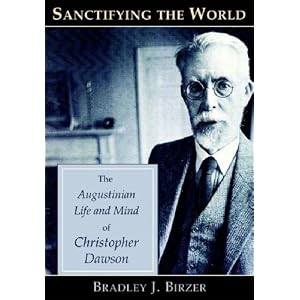
91. Sanctifying the World: The Augustinian Life and Mind of Christopher Dawson by Bradley Birzer
A great study of Christopher Dawson, who is one of the greatest historians ever.  However, biographies of thinkers often fall short of interest, except for this book.

92. The Scandal of the Evangelical Mind by Mark Noll
I am slowly trying to acquire more of Mark Noll's historical studies.  Recently read his book Jesus Christ and the Life of the Mind.

93. Southern Evangelicals and the Social Order, 1800-1860 by Anne Loveland
This is one of the best studies I ever read on Christianity in the Old South.  While I have not studied that much in recent years, it was one of my most central issues for a quite a while.

94. The Southern Tradition at Bay by Richard Weaver
I have nearly all of Richard Weaver's books.  He was a challenging thinker and a brilliant builder on the ideas of the Southern Agrarians.

95. The Southern Tradition: The Achievement and Limitations of American Conservatism by Eugene Genovese
If Eugene Genovese wrote it, I want it.  He is a great historian on Southern issues.

96. The Story of Christianity by Justo Gonzalez
This is one of many good church histories.  We use this book in several of my Humanities courses.

97. Theonomy In Christian Ethics by Greg Bahnsen
Greg Bahnsen was a friend.  He also preached my ordination sermon.  This was a deeply thought provoking study.


98. The Thread That Runs So True by Jesse Stuart
This is my favorite book about school teaching.  I have a life-long love of Jesse Stuart's writings and teaching.  I am currently reading his collection of sonnets titled Man With a Bull-Tongue Plow.

99. Tortured for Christ by Richard Wurmbrand
The Voice of the Martyrs still gives this book away.  It opened my eyes to the great issue of the cost of serving Christ when I first read it back around 1975.

100. The Twilight of Atheism by Alister McGrath
This is a good history of Atheism and key non-Christian and non-theistic thinkers.  I have accumulated several of McGrath's books in recent years.

Okay, there is more than 100 books.  This is a book blog, not a mathematical study.
101. Under the Influence: How Christianity Transformed Civilization by Alvin Schmidt
Great book.  It assembles lots of facts, figures, names, and events related to Christianity's impact in all areas of life.

102. The Unregenerate South: The Agrarian Thought of John Crowe Ransom, Allen Tate, and Donald Davidson by Mark Malvasi
This was one of the defining books in my quest some years back to study the Agrarians. 

103. The Victory of Reason: How Christianity Led to Freedom, Capitalism, and Western Success by Rodney Stark
I have acquired and I value all of Rodney Stark's studies on church history and sociology of Christianity.

Now mainly available as a used book.


104. The War: A Concise History, 1939-1945 by Louis Snyder
Has the world forgotten Louis Snyder?  I have read several of his books.  I read this one in high school and it furthered a love of studying World War II and other events in history.

105. Washington's Crossing by David Hackett Fischer
Everything by Fischer:  This book, Paul Revere's Ride, Albion's Seed, etc.

106. The World In The Grip of an Idea by Clarence Carson
This books helped clarify my dislike, rather, loathing of socialism and centralized Fascist and Marxist governments.  Carson's history of the United States is a good set of reference works, although a bit dry in style.

107. Worldly Saints by Leland Ryken
This is one of the best studies of the Puritans.  Dr. Ryken has written many fine books on literature and the Bible.  He is the teacher to one of my all time favorite students, Nick.

This is one of the key concepts undergirding all views of education, religion, and philosophy.


108. Worldview: The History of a Concept by David K. Naugle
I don't think I have read all of this book, but I have read portions of it several times.

109. The Years of Lyndon Johnson (3 volumes with the fourth forthcoming) by Robert Caro
This is a great history of 20th Century politics, with a behind the scenes story of lots of key political figures, besides the nefarious Lyndon Johnson.

Wednesday, February 08, 2012

Memories of 1976

Ronald Reagan and Rick Santorum
I have refrained from writing a political article this year.  Maybe it was because I have been too uncertain.  Maybe because the political landscape has been too depressing.  Maybe because the Internet feeds me so many interesting articles that I wonder why I should bother.

But last night's election sweep for Rick Santorum was great fun to watch.  The media had already gone on mental vacation.  After all, the critical state of Nevada voted on Saturday for Romney.  After all, the people of Florida had already spoken.  After all, the nomination was sewn up.  As New Hampshire and Florida goes, so goes the nation.  Romney, Romney, Romney!  It is settled.  Or was settled. Or should have been.

You have to win South Carolina to win the nomination and Romney was leading in South Carolina.  No Republican candidate has won both Iowa and New Hamshire, and yet Romney did.  And then it started unraveling.  Romney WON Iowa by six votes.  Then the recount showed he lost by 34 votes.  Oh, that means it is a tie, the officials then said.  After all, some of the precincts never sent in corrected vote counts, the officials said.  So who knows who really won Iowa?  Think for a minute.  If those missing precinct recounts could give Romney back his landslide victory, don't you think that the Romney money machine would plow up every field in Iowa to put him back in the winner's circle?  But it might cost a few million!  I am sure that Romney told his fellows to watch the pennies, hold back on doing the dirt and work, and let Iowa slide.

This political year has been fun.  It will be fun unless the Establishment and the Media get their way and wrap it up.  "Fighting this out will only lessen our chances of winning in November."  Sure, remember how John McCain's early clinching of the nomination strengthened him in November of 2008?  After all, it gave him time to raise enough money to give up campaigning in Michigan in October (because it was hopeless).  After all, the early end of the nomination process gave him time to carefully pick and vet a Vice Presidential candidate by late August.  (And Republicans lost a month's worth of campaigning because of Gov. Palin's family issues and poor interview performance.  And Palin was the most inspiring part of the McCain/Palin ticket.)

Remember how the Obama and Clinton fight which took them nearly all the way to the convention damaged Obama?  He was barely able to trounce McCain.  He barely was able to win traditional Republican states like Indiana, Virginia, and North Carolina.

It gets down to this:  Republicans--Remember North Carolina in 1976.

Ronald Reagan finally decided in late 1975 that he needed to challenge Gerald Ford for the Presidential nomination.  He called Ford and told him.  Ford didn't think he should challenge him.  He didn't think the Democrats should challenge him either.  He also didn't think the Russian Communist controlled eastern Europe.  He did favor carrying out Rutherford B. Hayes' plan to end Reconstruction of the South. 

Reagan lost New Hampshire by a small percentage.  For some weird reason, some people voted in the Democrat primary and wrote in Reagan's name.  If they had voted in the Republican primary, Reagan would have won.  President Ford and the Republican Washington Insiders Establishment probably assumed that since Reagan had the odd propensity of attracting Democrat voters, then he should not be the nominee. 

Reagan went on to lose more and more primaries.  The systems in New York and Pennsylvania were geared toward the party power holders.  Reagan didn't stand a chance.  He lost in Florida by a large margin.  In his birth state of Illinois, he pulled 40 percent of the votes.  He was finished. His campaign was over.  It was Ford, Ford, Ford.

And then came North Carolina:  Jesse Helms was one of the few Republican Senators who was willing to buck the establishment and support Reagan.  On election night--I still remember the news clip--Reagan won.  He then began winning in primary after primary, particularly in the South and the West.  He swept every delegate from Texas.  He fired up the conservative, southern, cowboy, red-neck, blue collar elements in the Republican Party.  ("Who are these people?" they must have been asking at the country clubs in the northeast.  "Why are they jamming up our primaries with nasty votes?")

Reagan came close to winning the nomination.  There were a few too many rungs in the Party establishment for Reagan to overcome, so Ford held on to the nomination.  Then Ford made a wise blunder.  He asked Reagan (He always called him "Ronnie") to say a few words.  Reagan did and electrified the Republican convention.  (According to many who were there, Republicans began having this sickening buyer's remorse over having purchased a lack-luster Ford.)

Ford did have a brilliant plan to win back the conservatives and Southerners, the cowboys and blue collar workers.  He picked Robert Dole of Kansas to be his running mate.  As a result, Kansas which was going to vote Republican by 60 percent of the vote in November went Republican by 61 percent of the vote.

I hate to keep talking about this group called the Establishment.  It begins to sound too conspiratorial.  Yet, every organization has insiders, power-holders, and an old guard.  In the field of country music, the establishment is the Nashville music executives who decided years ago that country music would do better if it did not sound like country music.  The Outlaws and other singers such as George Strait and Alan Jackson have begged to differ.

Yes, the Establishment rallied around the lackluster Gerald Ford.  "He is a conservative," they told us.  The establishment in 1980 rallied around George H.W. Bush.  If they had their way, Daddy Bush would have won the nomination in 1980, lost the race to Jimmy Carter that fall, and then much else would have followed that would have kept the more radically conservative elements out of the party.

It was establishment Republicans who promoted the nominations of those two war heroes Robert Dole (in 1996) and John McCain (in 2008).  After all, they reasoned, the Whig Party won elections with Presidents William Henry Harrison and Zachary Taylor.  It seems to be ingrained in the Party Establishment that a Presidential nomination should go to the person who has patiently waited for it and hasn't rocked the Establishment vote.  People are wanting something new, energetic, and outside Washington, so let's give them old Senators.  Apart from abysmal speaking styles, dull minds, lackluster campaigning techniques, both Dole and McCain (and Daddy Bush in 1992) proved to the world that losing a debate (or a series of debates) to mediocre Democrat debaters takes real effort.

This political year comes along and at least 300 times already, Willard Romney has been granted the nomination.  He is the only one who can, after all, defeat President Obama.  After all, he ran against Teddy Kennedy and lost by nearly 20 points.  After all, he understands the working man, for he has purchased factories filled with working men.  He knows what it is like to start a business.  Every person struggling in a little store feels like Mitt is right at his side.  And Willard Mitt will attract lots and lots of Democrats and Independents.  Why, every Democrat and Independent I know just loves Romney and thinks that his work on the Olympics is a model for every true American.

Why, I keep asking myself, do we have 50 plus primaries and caucuses if only 2 or 3 of them are supposed to pick a candidate? 

There is much to be said for Rick Santorum.  He has surprised me with every comeback and with every victory over conventional wisdom.  It is not hard to pick the conservative in this race.  It is not hard to decide who best represents the moral values of conservtives.

There are still overwhelming Establishment hurdles.  Even Ronald Reagan felt compelled to put Establishment pawn George H.W. Bush on his ticket.  I am hoping that Rick Santorum's staff, organization, and money all keep improving.  Romney showed in Florida that he plays rough.  If Rick Santorum ever cheated off your math assignment in high school, contact the Romney people now. 

In the meantime, here is what should happen:
1.  Newt Gingrich should seriously consider dropping out of the race and endorsing Santorum.  Newt is smarter than the other candidates and the incumbent President.  He has more and better experiences than any of them.  He is the better debater.  But his sins and failings past and present raise too many doubts.  He did a great job derailing Romney in South Carolina, and he can pick up some support in Southern state primaries on Super Tuesday and beyond.  Yet the baggage remains and the oddities of his personality and style.  He could pass the mantle of Ronald Reagan on to Rick Santorum.

2.  Ron Paul needs to drop out of the race and endorse Santorum.  This ego-trip, this mission to the young and restless, this late-in-life fame and acclaim has to be a heady experience for a man who has had a lonely legislative career.  Dr. Paul needs to look over Santorum's views and find one that he likes and support that.  Beyond that, he needs to do what he can to promote his own son's Senate career.  Paul has views that were racist and offensive, views that are quirky and unthinkable, views that are idealistic and impractical, and perhaps a few views that are good.  But in politics you have to build coalitions and get things done.  This distraction has gone on long enough.

I think the fun of this political year is just beginning.

Monday, February 06, 2012

Top 100 Non-Fiction Books, Part V

I need to hurry along on getting this project complete.  So I will list 20 books on this and another 20 on the next installment.


This is a powerful Christian work. I read it back in the 1970s and have never forgotten it.
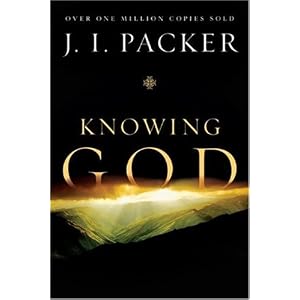
 61. Knowing God by J.I. Packer.
This is the best book by one of the best, most evangelical, most Puritan-like writers of our age. Packer's book on the Puritans is worthwhile and his book Evangelism and the Sovereignty of God is a theological classic.  And, if he had written nothing else, his essay or introduction to John Owen's Death of Death in the Death of Christ would stand alone as a chunk of gold.

62. Lectures on Calvinism by Abraham Kuyper.
All Christian worldview books, all books on Christian views of politics, science, and culture, all books that show us how to apply Christian thinking in the world derive in part from these lectures of Kuyper, which he delivered at Princeton in 1898.  Kuyper is a top shelf Christian thinker.  And, you cannot get into other Dutch Christian thinkers without Kuyper.

63. Literary Converts by Joseph Pearce.
Pearce does a great job in this book and several other biographical works in proclaiming God's grace to the field of literature and letters.  He covers British Christian writers in this book.  It includes sections on G.K. Chesterton, Hillaire Belloc, C.S. Lewis, T.S. Eliot, Christopher Dawson, and others.  Pearce also wrote a fine biography of Alexander Solzhenitsyn.

64. Mystery and Manners by Flannery O'Connor.
Along with being among the best of Southern authors and perhaps the best Christian short story writer, Flannery O'Connor left us this wonderful collection of essays about literature, Christian, Southern, and other. This book is a great companion volume to read alongside her fiction.

65. Mere Christianity by C.S. Lewis.
Lewis was so good in so many areas.  I am amazed everytime I go back to this book at how wonderful it is.  Of course, I really like Surprised by Joy also.  And I could mention...well, there is not enough time.

66. The Mind of the Maker by Dorothy Sayers.
Dorothy Sayers' essay "The Lost Tools of Learning" changed the direction of my teaching career.  This book is a powerful writing about the impact of God on our minds.  It is screaming for a second reading.


Don't read this unless you are ready to think.


67. The Myth of Religious Neutrality: An Essay on the Hidden Role of Religious Beliefs in Theories by Roy Clouser.
Dr. Clouser has promised me lunch with him if I ever get to New Jersey.  This book is a incredible piece of philosophical and theological writing.  Dr. Clouser is one of the best experts on Herman Dooyeweerd.

68. Nicholas and Alexander by Robert Massie.
Robert Massie wrote a historical biography that reads like a great fiction.  This is, perhaps, the best book to start with on reading about Russian history or the Russian Revolution.


I once started a chapter by chapter study guide on this work.


69. The One and the Many by R.J. Rushdoony
I have been greatly influenced by many of R.J. Rushdoony's books.  I could have listed a dozen different titles. This book is a survey of Western Civilization and the key thinkers who have impacted it.

70. Orthodoxy and Everlasting Man by G.K. Chesterton
Much to my regret, I started reading Chesterton not too many years ago.  I wish I had read and re-read lots more of him.
71. Our Southern Zion by Erskine Clark
Much of my academic career has involved reading, studying, and teaching about Calvinism in history and the American South. Here those two great historical rivers converge, just as two rivers converge in Charleston, South Carolina, the focal point of much of this history.

Prolific with books on many eras of history, including fiction.  His main area of expertise is the American War for Independence.
72. Perils of Peace by Thomas Fleming
This book covers the time after Yorktown and leading up to the Peace of Paris.
Thomas Fleming and I have had a few e-mail conversations over the past year or two.  He is one of the great historians on the War for Independence.  I have quite a few of his books and want to own every one of them.  What an amazing man.

73. The Politics of Rage: George C. Wallace, the Origins of the New Conservatism, and the Transformation of American Politics by Dan C. Carter
Another two loves of mine converge:  Political history and Southern history.  This is one of the most insightful political histories I have ever read.  George C. Wallace was a defining figure of twentieth century American politics.

Gene Edward Veith and another author in Houston in 2009.

74. Postmodern Times by Gene Edward Veith
I once had the honor of driving Dr. Veith back to his hotel.  (We did a weird u-turn and I drove up over the median.) Dr. Veith has written quite a few books on many topics.  He is a wide-ranging thinker and writer.  My favorite Veith book is Honky Tonk Gospel, which discusses the culture and Gospel influences in country music.

75. Predestination: The American Career of a Contentious Doctrine by Peter Theusen
This is an outstanding look at America's Christian history from the angle of groups that believed in Predestination.  From Puritans to modern preachers, this book covers lots of ground.

76. Principles of Conduct: Aspects of Biblical Ethics by John Murray
Or Redemption Accomplished and Applied or The Collected Writings of John Murray (4 volumes).  Murray was a great Scottish Presbyterian theologian.

77. Protestants and the Birth of a Revolution by Stephen Ozment
I have several of Ozment's books on the Reformation.  His book When Fathers Ruled is also a gem.  He is one of the best modern-day church historians on the topic of the Reformation (another favorite subject of mine).

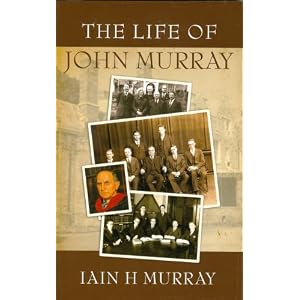
In this case, Iain Murray wrote about his fellow Scotsman, John Murray.


78. The Puritan Hope and Jonathan Edwards: A Biography by Iain Murray
Another Murray, another Scotsman, another great Calvinist writer.  Murray has written quite a few wonderful histories and biographies.  In recent years, I have enjoyed his Scottish Christian History and Heroes.

79. The Radicalism of the American Revolution by Gordon Wood
I read this for a graduate course several years back and became convinced that Gordon Wood must be one of the best thinking historians on America's founding era.  I have collected several of his works.

80. Rainbow for a Fallen World by Calvin Seerveld
This book contains some really great essays on applying Christian thought to literature, art, music, and all areas of life.  Wish I had studied under Seerveld.

Beautifully written book.  Not as widely known as it ought to be.

Saturday, February 04, 2012

New Readings

No waiting in line to pick up this definitive biography:

Defined the Cold War
No way to understand 20th Century foreign policy and the Cold War apart from the life, writings, and idea of George F. Kennan.  This is THE biography of this key statesman and thinker. Published by Penguin Group.

And a book that grew right out of the freshly turned up soil of 20th century Kentucky:


A wealth of sonnets

Kentucky novelist, short-story writer, teacher, and poet Jesse Stuart poured out over 700 poems--sonnets--in the early 1930s that defined, illustrated and sang the riches of the Agrarian life. 
Thanks to the Jesse Stuart Foundation for reprinting this classic.